
Homeowner Education

Home Resource and Knowledge Page

Careful, unhurried education for homeowners and families weighing questions about home equity, retirement planning, and the responsibilities that come with a Home Equity Conversion Mortgage.

Educational information only. The Pulpit & The People is not a mortgage lender, mortgage broker, loan originator, financial adviser, or law firm, and nothing on this page is an offer of credit or a recommendation to obtain any loan.

An older couple sitting together at their kitchen table, calmly reviewing household paperwork

Education Before Obligation

We believe a homeowner should understand a financial decision fully before anyone asks them to sign anything. This page exists to teach, not to sell a loan. There is no application here, no lender referral, no eligibility screening, and no pressure. Read slowly. Ask questions. Speak with a HUD-approved counselor and with professionals you trust before you make any decision about your home.

Portrait of Pastor Tyrone Simpson
Pastor Tyrone's Perspective

A personal, pastoral word on home equity and retirement

I have sat with too many families who made a major decision about their home while they were tired, afraid, or rushed. That is not the way to steward what God has entrusted to you.

A Home Equity Conversion Mortgage is not a blessing and it is not a curse. It is a financial tool with real benefits for some households and real costs and risks for others. For one family it may create breathing room in a difficult season. For another it may reduce what they hoped to leave behind, or create obligations they were not prepared to carry. Both outcomes are possible, and honesty requires that we say so.

My counsel is simple. Learn first. Bring your spouse, your adult children, and a trusted adviser into the conversation. Speak with a HUD-approved housing counselor. Read the responsibilities as carefully as you read the benefits. Pray about it. Then decide without anyone standing over you.

Wisdom is not rushed, and no one who loves you will pressure you to hurry.

This is Pastor Tyrone Simpson's personal educational perspective. It is not mortgage, legal, tax, accounting, investment, or financial advice, and it is not a recommendation for or against any loan product or any lender.

Understanding a Home Equity Conversion Mortgage

A Home Equity Conversion Mortgage, commonly called a HECM, is the reverse mortgage program insured by the Federal Housing Administration. The general description below is educational and is not a statement of what any particular homeowner would qualify for or receive.

What a HECM Is

A HECM is a loan secured by a borrower's home that allows eligible older homeowners to convert a portion of their home equity into loan proceeds. It is a loan, and like any loan it must eventually be repaid, with interest and applicable fees added to the balance over time.

General age requirement

All HECM borrowers generally must be at least 62 years old. A spouse who is younger than 62 may, in some circumstances, be identified as an eligible non-borrowing spouse. A non-borrowing spouse is not a borrower and may have different rights, protections, and limitations. Homeowners should discuss their household circumstances with a HUD-approved HECM counselor and an FHA-approved lender.

Other general eligibility conditions

Programs generally also require that the property be the borrower's principal residence and meet program property standards, that the homeowner have sufficient equity, that the homeowner complete counseling with a HUD-approved counselor, and that the homeowner meet the program's financial assessment requirements. Requirements can change and are determined by lenders and program rules, not by this website.

Existing mortgage payoff

If a homeowner still owes on an existing mortgage, HECM proceeds are generally used first to pay off that existing loan. Only the proceeds remaining after that payoff and after applicable costs may be available to the homeowner.

Monthly principal-and-interest payments

A HECM generally does not require a monthly mortgage principal-and-interest payment while program requirements continue to be met. This does not mean the home is paid for and it does not mean the household has no housing costs.

Continuing homeowner obligations

The borrower remains responsible for property taxes, homeowners insurance, any applicable homeowners association dues, property maintenance, and keeping the home as their principal residence. Failing to meet these obligations may cause the loan to become due and payable and may lead to foreclosure.

Repayment events

A HECM generally becomes due and payable when the last surviving borrower dies, sells the home, permanently moves out, no longer occupies the home as a principal residence for the period defined by the program, or fails to meet the loan's ongoing obligations. Repayment is typically satisfied by selling the home or refinancing, and any remaining equity after the loan is satisfied belongs to the borrower or their estate.

A HECM does not erase mortgage debt. It replaces one obligation with another, and the loan balance generally grows over time as interest and fees accrue.

Possible HECM payment options

Depending on program rules, the loan chosen, and lender terms, proceeds may be made available in different ways. Availability, amounts, and terms vary and are determined by the lender and program rules.

Line of credit

Funds may be available to draw as needed, up to the available limit, rather than taken all at once.

Tenure payments

Equal monthly amounts may be available for as long as at least one borrower lives in the home as a principal residence and program requirements continue to be met.

Term payments

Equal monthly amounts may be available for a fixed number of months selected at closing.

Lump sum, when permitted

A single disbursement may be available in certain circumstances and under certain loan types, subject to program limits.

Combination options

Some programs may allow a combination, such as a partial line of credit together with monthly payments.

This page does not provide a payment calculator, an estimate of available proceeds, or an eligibility tool. Figures specific to a household can only come from a licensed professional after a full review.

Potential retirement-planning considerations

For some households, and only when eligible and appropriate, a HECM may be considered as part of a broader retirement plan. None of the following is promised, guaranteed, or offered here.

  • Possible cash-flow flexibility

    Eliminating a required monthly mortgage principal-and-interest payment may, for some households, free up monthly cash flow for other living costs. Property taxes, insurance, and upkeep still must be paid.

  • Potentially remaining in the home

    Some homeowners consider a HECM because they wish to remain in their home rather than sell or relocate, when program requirements can continue to be met.

  • A possible standby resource

    A line of credit, when available, might function as a standby resource for unexpected costs rather than being drawn immediately.

  • Potential sequencing flexibility

    Some financial professionals discuss whether home equity might be used in certain years so that other assets are drawn differently. Whether that is wise for a given household depends entirely on that household's full picture.

  • Non-recourse protection and heirs

    HECM loans are generally non-recourse. This typically means that when the loan becomes due and the home is sold to repay it, neither the borrower nor the estate is personally liable for more than the home's value at that time, subject to program rules. Heirs generally have options that may include repaying the loan balance, refinancing, selling the home, or allowing the lender to sell the home. Any remaining equity after the loan is satisfied generally belongs to the borrower or the estate. Heirs should seek their own legal and financial guidance.

Read this section carefully

Responsibilities, costs, and tradeoffs

This section deserves at least as much of your attention as the section above it. A HECM carries ongoing obligations and real tradeoffs, and misunderstanding them can put a home at risk.

  • The loan balance generally grows

    Because payments are typically not being made against the loan, interest, mortgage insurance premiums, and servicing costs are generally added to the balance. The amount owed usually grows over time, sometimes substantially over many years.

  • Home equity is reduced

    As the balance grows, the equity remaining in the home generally decreases. Less equity may remain for a future move, for long-term care costs, or for heirs.

  • Property taxes and insurance remain your obligation

    These must continue to be paid on time. Non-payment is one of the most common reasons a reverse mortgage becomes due and payable.

  • Maintenance remains your obligation

    The home must be kept in the condition the program requires. Deferred repairs can create a default.

  • Principal-residence requirement

    The home must remain the borrower's principal residence. An extended absence, including a lengthy stay in a care facility, may cause the loan to become due and payable under program rules.

  • Effect on heirs

    Heirs generally must repay the loan, often by selling or refinancing the home, within the timeframe program rules allow, if they wish to keep the property. Families should discuss this openly and in advance.

  • Fees and closing costs

    HECMs typically involve origination fees, mortgage insurance premiums, third-party closing costs, and ongoing servicing costs. These reduce the proceeds available and add to the balance owed.

  • Long-term suitability

    A HECM may be a poor fit for a homeowner who expects to move within a few years, whose household budget is already strained by taxes and insurance, or whose primary goal is preserving the home for heirs.

Two warnings deserve to be stated plainly. First, using a reverse mortgage to consolidate other debt can be costly and may simply move an obligation onto the home while reducing equity — it does not make debt disappear. Second, failing to pay property taxes or homeowners insurance, failing to maintain the property, or failing to keep the home as your principal residence may cause the loan to become due and payable and can result in foreclosure and loss of the home.

Homeowner consideration checklist

Use this as a personal study tool. Nothing you mark is scored, saved, or sent anywhere, and this checklist does not tell you whether a HECM is right for you. Bring your answers to a HUD-approved counselor and to professionals you trust.

This checklist does not evaluate eligibility, does not produce a score, and does not indicate whether a HECM is appropriate for you or anyone else.

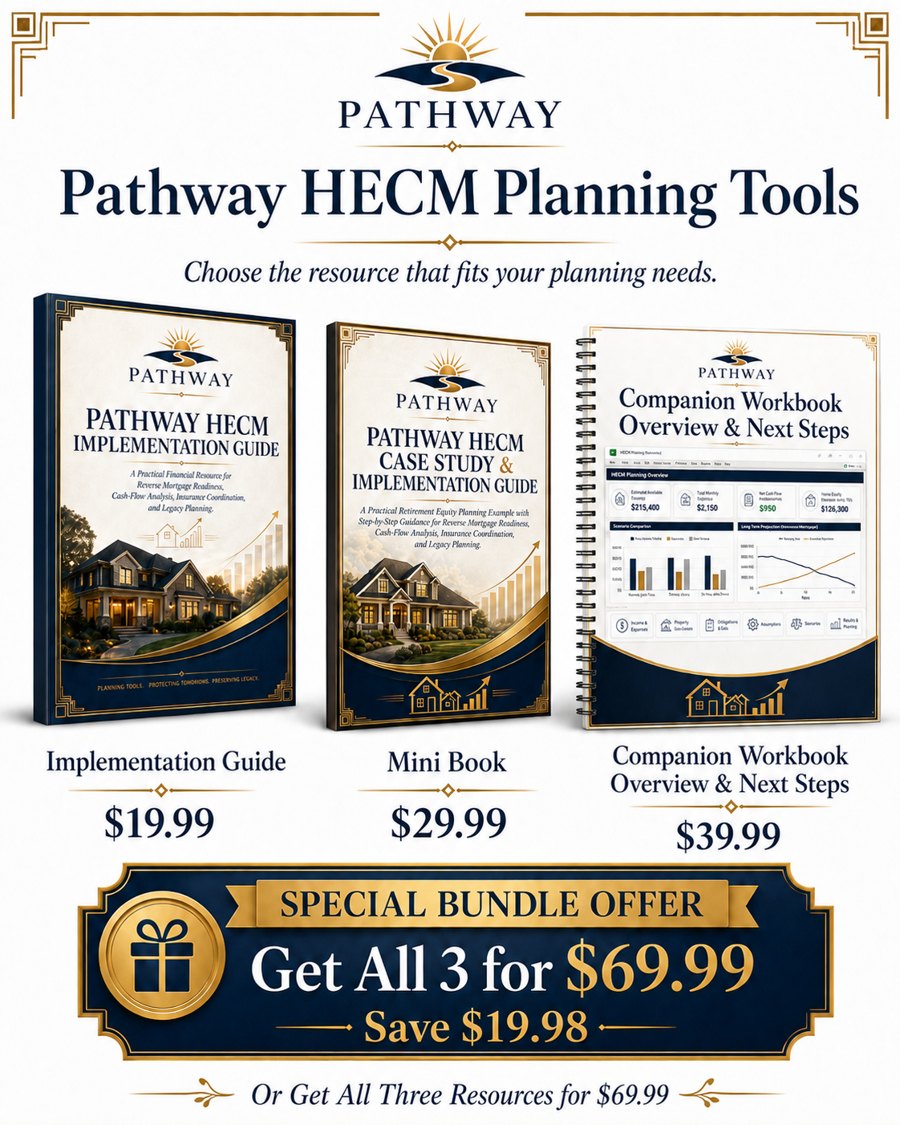
HECM Retirement Strategy Toolkit

Optional educational materials for homeowners and families who want an organized way to study these questions. These are study resources, not financial services.

HECM Retirement Strategy Guidebook

$9.99

A plain-language introduction to how a Home Equity Conversion Mortgage works, who it is generally designed for, and the questions a homeowner should study before going further.

Pathway HECM Implementation Guide

$29.99

A structured educational walkthrough of the general HECM process, counseling requirements, document organization, and the ongoing responsibilities a borrower keeps.

HECM Retirement Income and Expense Workbook

$19.99

A printable organization workbook for listing household income, recurring expenses, and property costs so that a homeowner can review their own situation with a qualified professional.

Best value

Complete HECM Retirement Strategy Toolkit

$49.99

All three educational resources together — the guidebook, the implementation guide, and the income and expense workbook — as one bundled study set.

You will continue to Stan Store to complete your purchase securely.

Purchases are securely completed through our external Stan Store. The Pulpit & The People website does not collect or store your payment-card information.

Purchase of these educational materials does not include a mortgage application, lender matching, loan approval, individualized mortgage advice or a guarantee of HECM eligibility or financial results.

Free homeowner checklist

10 Questions Every Homeowner Should Ask Before Considering a Reverse Mortgage

A free one-page checklist you can print and bring to a HUD-approved counselor, a family meeting, or a conversation with your own adviser. We will send it to your email along with occasional homeowner education. You can unsubscribe at any time.

We only ask for your first name, email address, and interest category. We never request Social Security numbers, birth dates, income, property value, mortgage balance, credit information, property addresses, or loan amounts.

Frequently asked questions

Official information resources

These independent government resources are provided for your own research. Links open the organizations' own websites.

These links are provided for informational convenience only. The Pulpit & The People is not affiliated with, endorsed by, sponsored by, or acting on behalf of any government agency, and no government endorsement is implied.

Learn first. Decide without pressure.

Take the checklist with you. Speak with a HUD-approved counselor. Talk with your family and with professionals you trust. When you understand the responsibilities as clearly as the possibilities, you are ready to make your own decision — and not a moment before.

Important Educational and Legal Disclosure

Who we are

The Pulpit & The People, and Pathway Investments 101, LLC, provide general educational information only. We are not a mortgage lender, mortgage broker, loan originator, mortgage servicer, financial adviser, investment adviser, insurance producer, tax adviser, accountant, or law firm, and no content on this page constitutes mortgage, financial, investment, insurance, tax, accounting, or legal advice.

What we do not provide

Nothing on this page is an offer to lend, a commitment to lend, a solicitation of a mortgage application, a loan approval, a determination of eligibility, or a recommendation of any lender, loan product, or financial strategy. We do not take mortgage applications, do not match homeowners with lenders, and do not receive compensation for mortgage referrals.

Important HECM responsibilities

A Home Equity Conversion Mortgage is a loan that must be repaid. The loan balance generally increases over time as interest and fees accrue, and home equity generally decreases. Borrowers remain responsible for property taxes, homeowners insurance, applicable association dues, property maintenance, and keeping the property as their principal residence. Failure to meet these obligations may cause the loan to become due and payable and may result in foreclosure and loss of the home.

Program rules and individual results

Program rules, eligibility criteria, costs, interest rates, and available payment options are established by the U.S. Department of Housing and Urban Development, the Federal Housing Administration, and participating lenders, and they may change. Individual results vary, and no financial outcome, savings, proceeds amount, approval, or eligibility is promised or guaranteed. HECM program rules generally require counseling with a HUD-approved housing counselor, and homeowners are strongly encouraged to consult a HUD-approved counselor and their own licensed mortgage, legal, tax, and financial professionals before making any decision involving their home.

No government affiliation

The Pulpit & The People is not affiliated with, endorsed by, or sponsored by HUD, FHA, the Consumer Financial Protection Bureau, the Florida Office of Financial Regulation, or any other government agency. References to those agencies are for informational purposes only.

Educational product purchases

Educational products offered on this page are study materials only. Purchase does not include a mortgage application, lender matching, loan approval, individualized mortgage advice, or any guarantee of HECM eligibility or financial results. Purchases are completed through our external Stan Store; this website does not collect or store payment-card information.

Last reviewed: 2026-08-06